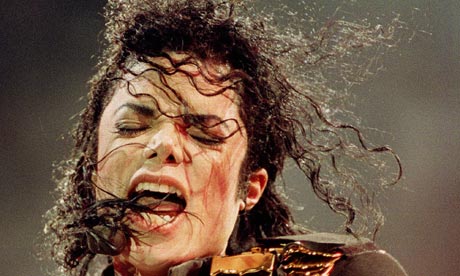
Michael Jackson was unquestionably the biggest pop star of the '80s, and certainly one of the most popular recording artists of all time. In his prime, Jackson was an unstoppable juggernaut, possessed of all the tools to dominate the charts seemingly at will: an instantly identifiable voice, eye-popping dance moves, stunning musical versatility, and loads of sheer star power. His 1982 blockbuster Thriller became the biggest-selling album of all time (probably his best-known accomplishment), and he was the first black artist to find stardom on MTV, breaking down innumerable boundaries both for his race and for music video as an art form. Yet as Jackson's career began, very gradually, to descend from the dizzying heights of his peak years, most of the media's attention focused on his increasingly bizarre eccentricities; he was often depicted as a man-child in a state of arrested development, completely sheltered from adult reality by a life spent in show business. The snickering turned to scandal in 1993, when Jackson was accused of molesting a 13-year-old boy; although he categorically denied the charges, his out-of-court settlement failed to restore his tarnished image. He never quite escaped the stigma of those allegations, and while he continued to sell records at superstar-like levels, he didn't release them with enough frequency (or, many critics thought, inspiration) to once again become better known for his music than his private life. Whether as a pop icon or a tabloid caricature, Jackson always remained bigger than life.
Michael Joseph Jackson was born August 29, 1958, in Gary, IN. The fifth son of steelworker Joe Jackson, Michael displayed a talent for music and dance from an extremely young age. His childhood was strictly regimented; from the start he was, to an extent, sheltered from the outside world by his mother's Jehovah's Witness faith, and his father was by all accounts an often ill-tempered disciplinarian. Joe began to organize a family musical group around his three eldest sons in 1962, and Michael joined them the following year, quickly establishing himself as a dynamic stage performer. His dead-on mastery of James Brown's dance moves and soulful, mature-beyond-his-years vocals made him a natural focal point, especially given his incredibly young age. Dubbed the Jackson 5, the group signed to Motown in 1968 and issued their debut single in October 1969, when Michael was just 11 years old. "I Want You Back," "ABC," "The Love You Save," and "I'll Be There" all hit number one in 1970, making the Jackson 5 the first group in pop history to have their first four singles top the charts. Motown began priming Michael for a solo career in 1971, and his first single, "Got to Be There," was issued toward the end of the year; it hit the Top Five, as did the follow-up, a cover of Bobby Day's "Rockin' Robin." Later in 1972, Jackson had his first number one solo single, "Ben," the title song from a children's thriller about a young boy who befriends Ben, the highly intelligent leader of a gang of homicidal rats. Given the subject matter, the song was surprisingly sincere and sentimental, and even earned an Oscar nomination. However, the momentum of Jackson's solo career (much like that of the Jackson 5) soon stalled. He released his fourth and final album on Motown in 1975, and the following year, he and his brothers (save Jermaine) signed to Epic and became the Jacksons.
In 1977, Jackson landed a starring role alongside Diana Ross in the all-black film musical The Wiz, a retelling of The Wizard of Oz; here he met producer/composer Quincy Jones for the first time. Encouraged by the success of the Jacksons' self-produced, mostly self-written 1978 album Destiny, Jackson elected to resume his solo career when his management contract with his father expired shortly thereafter. With Jones producing, Jackson recorded his first solo album as an adult, Off the Wall. An immaculately crafted set of funky disco-pop, smooth soul, and lush, sentimental pop ballads, Off the Wall made Jackson a star all over again. It produced four Top Ten singles, including the number one hits "Don't Stop 'Til You Get Enough" and "Rock with You," and went platinum (it went on to sell over seven million copies); even so, Jackson remained loyal to his brothers and stayed with the group.
No group could have contained Jackson's rapidly rising star for long; however, there was still no sign (if there ever could be) that his next album would become the biggest in history. Released in 1982, the Quincy Jones-produced Thriller refined the strengths of Off the Wall; the dance and rock tracks were more driving, the pop tunes and ballads softer and more soulful, and all of it was recognizably Michael. Jackson brought in Paul McCartney for a duet, guitarist Eddie Van Halen for a jaw-dropping solo, and Vincent Price for a creepy recitation. It was no surprise that Thriller was a hit; what was a surprise was its staying power. Jackson's duet with McCartney, "The Girl Is Mine," was a natural single choice, and it peaked at number two; then "Billie Jean" and the Van Halen track "Beat It" both hit number one, for seven and three weeks, respectively. Those latter two songs, as well as the future Top Five title track, had one important feature in common: Jackson supported them with elaborately conceived video clips that revolutionized the way music videos were made. Jackson treated them as song-length movies with structured narratives: "Billie Jean" set the song's tale of a paternity suit in a nightmarish dream world where Jackson was a solitary, sometimes invisible presence; the anti-gang-violence "Beat It" became an homage to West Side Story; and the ten-plus-minute clip for "Thriller" (routinely selected as the best video of all time) featured Jackson leading a dance troupe of rotting zombies, with loads of horror-film makeup and effects. Having never really accepted black artists in the past, MTV played the clips to death, garnering massive publicity for Jackson and droves of viewers for the fledgling cable network. Jackson sealed his own phenomenon by debuting his signature "moonwalk" dance step on May 16, 1983, on Motown's televised 25th anniversary special; though he didn't invent the moonwalk (as he himself was quick to point out), it became as much of a Jackson signature as his vocal hiccups or single white-sequined glove.
Showing no signs of slowing down, Thriller just kept spinning off singles, including "Wanna Be Startin' Somethin'," the airy ballad "Human Nature," and "P.Y.T. (Pretty Young Thing)"; in all, seven of its nine tracks wound up in the Top Ten, obliterating conventional ideas of how many singles could be released from an album before it ran its course. Thriller stayed on the charts for over two years, spent 37 non-consecutive weeks at number one, and became the best-selling album of all time; it went on to sell 29 million copies in the U.S. alone, and around another 20 million overseas. Naturally, Jackson won a slew of awards, including a record eight Grammys in one night, and snagged the largest endorsement deal ever when he became a spokesman for Pepsi (he would later be burned in an accident while filming a commercial). At the end of 1983, Jackson was again on top of the singles charts, this time as part of a second duet with McCartney, "Say Say Say." In 1984, Jackson rejoined his brothers one last time for the album Victory, whose supporting tour was one of the biggest (and priciest) of the year. The following year, he and Lionel Richie co-wrote the anthemic "We Are the World" for the all-star famine-relief effort USA for Africa; it became one of the fastest-selling singles ever.
Even at this early stage, wild rumors about Jackson's private life were swirling. His shyness and reluctance to grant interviews (ironically, due in part to his concerns about being misrepresented) only encouraged more speculation. Some pointed to his soft-spoken, still girlish voice as evidence that he'd undergone hormone treatments to preserve the high, flexible range of his youth; stories were told about Jackson sleeping in a hyperbaric chamber to slow the aging process, and purchasing the skeleton of John Merrick, the Elephant Man (Jackson did view the bones in the London Hospital, but did not buy them). Jackson bought a large ranch in California which he dubbed Neverland, and filled it with amusement park rides and animals (including the notorious pet chimpanzee Bubbles), which only fueled the public's perception of him as a somewhat bizarre eccentric obsessed with recapturing his childhood. He also underwent cosmetic surgery several times, which led to accusations from the black community that his gradually lightening skin tone was the result of an intentional effort to become whiter; a few years later, Jackson revealed that he had a disorder called vitiligo, in which pigment disappears from the skin, leaving large white blotches and making direct sunlight dangerous. One of the rumors that was definitely true was that Jackson owned the rights to the Beatles' catalog; in 1985, he acquired ATV Publishing, the firm that controlled all the Lennon-McCartney copyrights (among others), which wound up costing him his friendship with McCartney.
During his long layoff between records, Jackson indulged his interest in film and video by working with George Lucas and Francis Ford Coppola on the 3-D short film Captain Eo. The special-effects extravaganza was shown at the enormous widescreen IMAX theaters in Disney's amusement parks for 12 years, beginning in 1986. Finally, Jackson re-entered the studio with Quincy Jones to begin the near-impossible task of crafting a follow-up to Thriller. Bad was released to enormous public anticipation in 1987, and was accompanied by equally enormous publicity. It debuted at number one, and the first single, "I Just Can't Stop Loving You," with vocal accompaniment by Siedah Garrett, also shot up the charts to number one. Like Thriller, Bad continued to spin off singles for well over a year after its release, and became the first album ever to produce five number one hits; the others were "Bad," "The Way You Make Me Feel," "Man in the Mirror," and "Dirty Diana." Jackson supported the album with a lengthy world tour that featured a typically spectacular, elaborate stage show; it became the highest-grossing tour of all time. Although Jackson's success was still staggering, there were faint undercurrents of disappointment, partly because of the unparalleled phenomenon of Thriller (Bad "only" sold eight million copies in American, along with at least double that number overseas), and partly because the album itself didn't seem quite as exuberant or uniformly consistent when compared to its predecessors.
Jackson took another long hiatus between albums, giving the media little to focus on besides his numerous eccentricities; by this time, the British tabloids delighted in calling him "Wacko Jacko," a name he detested. When Jackson returned with a new album in late 1991, he'd come up with a different moniker: "The King of Pop." Dangerous found Jackson ending his collaboration with Quincy Jones in an effort to update his sound; accordingly, many of the tracks were helmed by the groundbreaking new jack swing producer Teddy Riley. As expected, the album debuted at number one, and its lead single, "Black or White," shot to the top as well. Jackson courted controversy with the song's video, however; after the song itself ended, there was a long dance sequence in which Jackson shouted, grabbed his crotch, and smashed car windows in a bizarre display that seemed at odds with the song's harmonious message. With the video given a high-profile, prime-time network premiere, Jackson was criticized for the inappropriate violence and the message it might send to his younger fans. However, Jackson would not be the biggest story in popular music for long. In early 1992, Nirvana's Nevermind symbolically knocked Dangerous out of the number one spot; after the alternative rock revolution, the pop charts would never be quite the same. Jackson scored several more hits off the album, including the Top Tens "Remember the Time" and "In the Closet," but the aggressive "Jam" and the saccharine "Heal the World" both performed disappointingly.
Jackson had long preferred the company of children over other adults, and befriended quite a few, inviting them to stay at his Neverland Ranch and enjoy the massive playground he'd assembled over the years. In 1993, Jackson was accused of molesting a 13-year-old boy who'd become a frequent guest at Neverland. Predictably, there was a tabloid feeding frenzy, and a mainstream media circus as well. In the court of public opinion, the charges seemed all too plausible: Jackson was near-universally perceived as a weirdo, and here was a handy explanation for his heretofore asexual persona and distaste for adult companions. Additionally, Jackson entered rehab for a short time, seeking treatment for an addiction to pain killers. Investigations were unsuccessful in turning up any other boys who echoed the allegations, and Jackson countersued his accusers for attempting extortion; however, in spite of the fact that no criminal charges were ever filed against Jackson, he settled the boy's family's suit out of court in early 1995, paying an estimated 18 to 20 million dollars. Many felt the settlement was tantamount to an admission of guilt, and when Jackson married Lisa Marie Presley in 1994, the move was perceived as a desperate ploy to rehabilitate his image; the marriage broke up just 19 months later, seemingly lending credence to the charge.
In 1995, Jackson attempted to put the focus back on his music by preparing HIStory: Past, Present and Future, Book 1, a two-CD set featuring one disc of new material and one of his greatest hits. The album debuted at number one, but the format backfired on Jackson: his fans already owned the hits, and the new album simply wasn't strong enough to offset the added cost of the extra disc for many more casual listeners. There were some encouraging signs -- the lead single "Scream," a duet with sister Janet, debuted at number five, setting a new American chart record that was broken when the follow-up, "You Are Not Alone," became the first single ever to enter the Billboard Hot 100 at number one. But on the whole, HIStory was something of a disappointment. Additionally, Jackson collapsed during rehearsals for an awards show later that year, and had to be rushed to the hospital; what was more, the Eagles' Their Greatest Hits (1971-1975) was threatening to catch Thriller's American sales record (it eventually did, and the two continued to run neck and neck). There were signs that Jackson was grasping at his self-proclaimed King of Pop status; the cover of HIStory depicted an enormous statue of Jackson, and he performed at the 1996 BRIT Awards dressed as a Messiah, with children and a rabbi surrounding him worshipfully (Pulp lead singer Jarvis Cocker stormed the stage to protest Jackson's hubris during the middle of the song). The 1997 remix album Blood on the Dance Floor failed to even go platinum, although remix albums historically don't perform nearly as well as new material.
In late 1996, Jackson remarried, to nurse Debbie Rowe; over the next two years, the couple had two children, son Prince Michael Jackson, Jr. and daughter Paris Michael Katherine Jackson. However, Jackson and Rowe divorced in late 1999. In 2001, Jackson was inducted into the Rock & Roll Hall of Fame, and later held a massive concert at Madison Square Garden celebrating the 30th anniversary of his first solo record. Among many other celebrity guests, the show featured the first on-stage reunion of the Jacksons since the Victory tour. In the wake of September 11, Jackson put together an all-star charity benefit single, "What More Can I Give." His new album, Invincible, was released late in the year, marking the first time he'd issued a collection of entirely new material since Dangerous; it found him working heavily with urban soul production wizard Rodney Jerkins. Invincible debuted at number one and quickly went double platinum; however, its initial singles, "You Rock My World" and "Butterflies" had rather disappointing showings on the charts, with the latter not even reaching the Top Ten. To compound matters, the expensive "What More Can I Give" single and video were canceled by Sony when executive producer Marc Schaffel was revealed to have worked in pornography. Jackson's camp tried to distance the singer from Schaffel, and the various corporations that were attached to it (McDonalds, Sony) claimed they had minimal involvement if any with the song. Sony and Jackson began a press war in the summer of 2002, starting with Jackson's claims that the label asked for 200 million dollars to pay them back for marketing costs. Although they had spent 55 million on his disappointing comeback, Sony released a statement saying that no such request had ever been made. Jackson stewed for a few weeks before launching a press attack on Sony Music chairman Tommy Mottola, calling him "devilish" and making claims that he used racist language and held down black artists. Many Sony artists, including Mariah Carey and Ricky Martin, defended Mottola, but Jackson and his family maintained that racism ended their professional relationship.
From that point on, Jackson's career took an extreme turn toward the bizarre, starting with MTV's annual Video Awards. When Britney Spears presented him with a birthday cake, an offhand remark about being the artist of the millennium inspired a rambling Jackson to accept a meaningless trophy (which everyone presenting on-stage received) as an actual Artist of the Millennium award. Next came accusations from a promotional company over his promises of a tour and several appearances that he then canceled. Jackson arrived in court late, gave a drowsy testimony, and inspired gasps when he removed a surgical mask to reveal his nose had caved in from a botched cosmetic surgery. Only days later, German fans were horrified when Jackson came to the balcony of his hotel suite and briefly dangled his 11-month-old baby Prince Michael II (nicknamed "Blanket" by Jackson) over the edge with one arm. Although he apologized the next day, claiming he had gotten caught up in the moment, this only did more to cement the King of Pop's public image as an out-of-control millionaire. The year 2003 turned out not to be a good one for Jackson: in November, his Neverland Ranch was extensively searched by police, whereby he was subsequently arrested on charges of child molestation. That same month the single-disc retrospective Number Ones hit the stands with one new song, "One More Chance." A year later -- nearly to the day -- the four-CD/one-DVD box set The Ultimate Collection appeared with numerous rarities, including the original demo for "We Are the World." In January 2005, his child molestation trial began, and by May he was acquitted on all counts. Jackson soon relocated to the Persian Gulf island of Bahrain and began working on new music, including a charity single that would benefit victims of Hurricane Katrina. The single never appeared, but the two-disc The Essential Michael Jackson did, and in 2006 the strange box set Visionary was released, featuring 20 DualDiscs replicating 20 big hit singles with their videos included on the DVD side. In early 2007, it was announced that a comeback album was planned for late in the year, but the album never materialized.
In early 2009, Jackson announced an ambitious comeback, dubbed This Is It, including a series of ten concerts at O2 Arena in London. (After high ticket sales, the number was later increased to 50.) He rehearsed extensively in Los Angeles during the spring, but on the afternoon of June 25, 2009, he was found unresponsive at his home. Jackson was rushed to the UCLA Medical Center, where he was pronounced dead at the age of 50. His death was later ruled a homicide, the result of ingesting a lethal amount of prescription drugs. Unsurprisingly, a slew of releases ensued -- planned prior to and after Jackson's death -- including Motown's Michael Jackson: The Remix Suite and a soundtrack for Michael Jackson's This Is It (a film based on Jackson's rehearsals for the comeback concerts). Michael Jackson's Vision, a comprehensive DVD set, and Michael, a collection of finished outtakes largely recorded in the years following Invincible but also containing some songs dating back to Thriller, appeared during the holiday season of 2010. ~ Steve Huey, Rovi